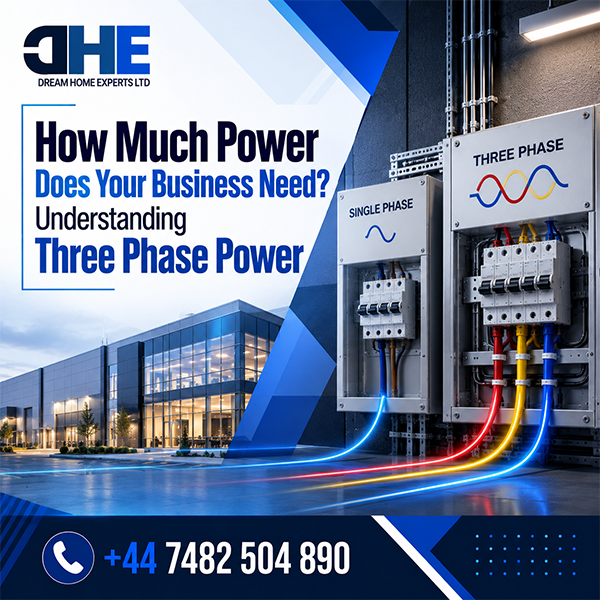
How much power does my business need is one of the most common questions we get from businesses planning a fit-out, adding equipment, or simply noticing their current supply can’t keep up. The honest answer depends on what’s actually running in the building, but there’s a clear process for working it out rather than guessing.
Working Out How Much Power Your Business Actually Needs
Every piece of electrical equipment has a power rating, usually listed in kilowatts (kW) or amps, printed on a data plate or in the manual. Adding up the rated power of everything that might run at the same time gives a rough starting point, though real usage rarely means everything runs simultaneously at full load. A proper assessment accounts for typical usage patterns, not just the theoretical maximum.
Offices with standard equipment, computers, lighting, printers, and small kitchen appliances, usually sit comfortably within a single phase supply’s capacity. The calculation shifts considerably once heavier equipment enters the picture: commercial refrigeration, industrial machinery, workshop tools, or multiple pieces of equipment drawing significant current at once.
Common Business Types and Their Typical Power Needs
Small offices and retail units generally need less power than owners expect, since modern lighting and computer equipment draws relatively little compared to older systems. Restaurants and cafes sit higher on the scale because of commercial kitchen equipment: ovens, extraction systems, and refrigeration units all draw substantially more than standard office equipment.
Warehouses and light industrial units vary the most, depending heavily on whether machinery is present and how much of it runs concurrently. A warehouse used purely for storage with basic lighting needs far less than one running conveyor systems, compressors, or heavy loading equipment.
Why Getting the Number Wrong Gets Expensive
Underestimating power needs early leads to problems down the line: tripped circuits, equipment that can’t run at full capacity, or a costly mid-project supply upgrade once machinery has already been ordered. Overestimating isn’t free either, since a larger supply connection often comes with higher standing charges that a business ends up paying for capacity it never actually uses.
Signs Your Current Supply Isn’t Enough
Breakers tripping when multiple pieces of equipment run together, motors struggling to start under load, or a supplier flagging capacity concerns when new equipment is proposed are all common signs the existing power supply is being pushed past what it was designed for. Businesses planning to bring in equipment rated higher than their current connection should check the supply before, not after, ordering.
Factoring in Future Growth
Businesses answering how much power does my business need for the first time often size the calculation around current equipment only, then find themselves short again within a year or two of growth. Factoring in planned expansion, additional equipment, or extra staff workstations at the outset usually costs less than a second upgrade shortly after the first one.
This doesn’t mean over-specifying a supply far beyond realistic needs. It means having an honest conversation with an electrician about growth plans during the initial survey, rather than treating the current headcount and equipment list as fixed forever.
How a Site Survey Answers the Question Properly
The most reliable way to answer how much power does my business need is a proper site survey, rather than adding up nameplate ratings alone. An electrician assesses the building’s existing supply, current equipment, and planned additions, then calculates the actual demand accounting for realistic usage patterns rather than worst-case totals. This is also the point where a single phase versus three phase decision usually gets made, since heavier or more consistent loads often point toward a three phase supply.
Businesses expanding into units around Winterhill or Caldecotte, where light industrial space is common, often find their existing single phase supply is borderline once new equipment gets factored in, which makes a survey worth doing before committing to a purchase.
There’s rarely a single fixed answer to how much power does my business need, since the figure shifts as equipment, staffing, and floor space change over time. Treating it as a one-off calculation rather than something revisited periodically is one of the more common planning mistakes we see.
Getting an Accurate Power Assessment
Guessing at power requirements before ordering equipment is a common and avoidable mistake. Dream Home Electrical has spent 35 years assessing commercial and industrial power needs across Milton Keynes, and our team can survey your property, calculate your actual requirements, and advise honestly on whether your current supply is sufficient or needs upgrading.
Not sure how much power your business needs? Get in touch with our team for a free site survey, or call us on 01908 464431.
Frequently Asked Questions
How do I calculate my business’s power requirements?
Add up the rated power of equipment likely to run simultaneously, then have an electrician confirm with a proper site survey.
What happens if my power supply is undersized?
Breakers trip, equipment underperforms, and you may face a costly mid-project upgrade once machinery has already been ordered.
Do I need three phase power for my business?
Only if equipment draws heavy, continuous loads; most small offices and shops manage fine on single phase.
How much does a power assessment cost?
Costs vary by property size, but a site survey is the only reliable way to get an accurate figure.
Can I estimate power needs myself from equipment labels?
It’s a useful starting point, but real usage patterns and simultaneous loads need a proper electrician’s assessment.
When should I get a power assessment done?
Before ordering new equipment or signing a lease, not after machinery has already arrived on site.