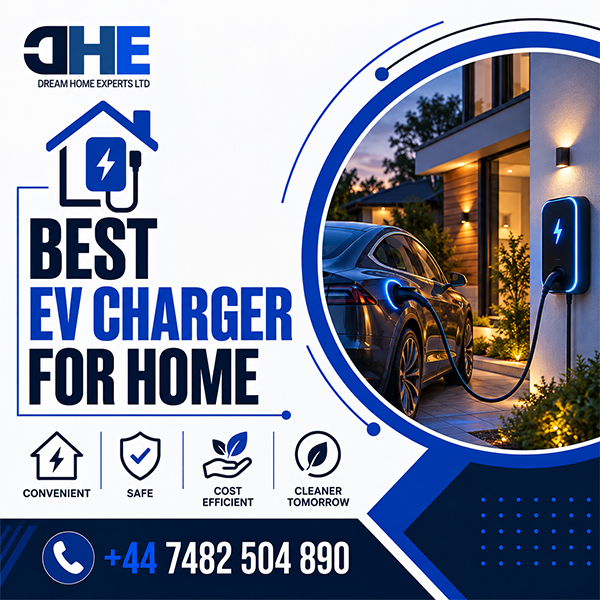
The best EV charger for home use isn’t the same for every household, since the right choice depends on your car, your driving habits, and what your home’s electrical supply can actually support. Getting it right from the start saves both money and the hassle of an upgrade down the line.
What Makes the Best EV Charger for Home Charging
A few factors decide which charger genuinely suits a specific home:
- Charging speed: most home chargers run at 7kW, giving a full charge overnight for the average EV
- Smart features: app control, scheduled charging during off-peak electricity rates, and usage tracking
- Tethered vs untethered: tethered chargers come with a built-in cable, while untethered units require you to bring your own
- Weatherproofing: essential for outdoor installations, particularly on driveways without covered parking
- Compatibility: confirming the charger works with your specific EV model and its charging port type
- OZEV grant eligibility: some chargers and installers qualify for government funding support
7kW vs 22kW Home Chargers
Most homes are supplied with a single phase electrical connection, which limits practical home charging to 7kW. A 7kW charger typically adds around 25 to 30 miles of range per hour of charging, which comfortably covers an overnight charge for most daily driving patterns.
22kW chargers exist, but they require a three phase electrical supply, which most homes don’t have and rarely need. Unless a home already has three phase power installed for other reasons, a 7kW charger remains the practical, cost-effective choice for home charging.
Smart Chargers vs Basic Chargers
Smart EV chargers connect to home WiFi and an app, allowing scheduled charging during cheaper overnight electricity rates, usage monitoring, and remote control. Since mid-2022, UK regulations have required most new home chargers to include smart charging capability, so this is now the standard rather than a premium extra.
Basic chargers, where still available, simply deliver power without the scheduling or monitoring features. For most households, the running cost savings from scheduled off-peak charging alone make a smart charger worth choosing over a basic unit.
Tethered or Untethered: Which Should You Choose?
Tethered chargers come with a cable permanently attached, which is more convenient day to day since there’s no separate cable to store or forget. Untethered chargers require you to plug in your own cable each time, offering slightly more flexibility if you switch between vehicles with different charging cable types, though this is a less common need for most single-car households.
Where Should Your Home Charger Be Installed?
Location affects both cost and convenience. A charger installed close to the consumer unit costs less to wire in than one requiring a longer cable run across a driveway or garden. Outdoor installations need weatherproof-rated equipment regardless of distance, while garage installations sometimes avoid this requirement depending on the setup.
Homeowners across Newport Pagnell, Olney, and Great Linford considering a home charger installation often find a short site visit clarifies the ideal location and cabling route before committing to a specific model.
Matching the Charger to Your Actual Driving Habits
The best EV charger for home use isn’t necessarily the fastest or most feature-heavy option on the market. A household covering modest daily mileage rarely needs anything beyond a standard 7kW smart charger, since even a partially depleted battery tops back up comfortably overnight. Households with higher daily mileage, or more than one EV to charge, might benefit more from scheduling features and app-based monitoring than from any increase in raw charging speed.
Thinking through actual usage first, rather than choosing based on spec sheets alone, usually leads to a better long-term decision than picking the most expensive available unit.
What Does a Home EV Charger Typically Cost?
Pricing for the best EV charger for home use varies by unit, installation complexity, and cable run length. Straightforward installations close to the consumer unit cost less than those requiring longer cable runs, additional groundwork, or an upgraded consumer unit to support the new circuit. Some households may also need a load management device fitted alongside the charger if the existing supply is close to capacity, which adds a modest cost but avoids overloading the property’s electrical system.
Grant funding through OZEV can offset part of the installation cost for eligible households and properties, though eligibility rules have narrowed over time, so it’s worth confirming current criteria with your installer before assuming a discount applies.
Getting the Right EV Charger Installed
Choosing the best EV charger for home use is only half the decision. Installation by a qualified, OZEV-approved electrician ensures the unit is fitted safely, correctly certified, and eligible for any available grant funding. Dream Home Electrical has 35 years of electrical installation experience across Milton Keynes and is approved to install home EV chargers to current safety standards.
Ready to choose and install a home EV charger? Get in touch with our team for a free consultation, or call us on 01908 464431.
Frequently Asked Questions
What’s the best home EV charger speed for most households?
A 7kW charger, which comfortably delivers a full overnight charge for typical daily driving.
Do I need a smart charger?
Most new installations require smart functionality by regulation, and it also enables cheaper off-peak charging.
Should I choose a tethered or untethered charger?
Tethered chargers are more convenient day to day; untethered offers flexibility across different vehicles.
Can I install a 22kW charger at home?
Only if your home has a three phase electrical supply, which most residential properties don’t have.
Does charger location affect installation cost?
Yes. Chargers installed further from the consumer unit generally cost more due to additional cabling.
Is government funding available for home EV chargers?
Some installations remain eligible for OZEV grant support; your installer can confirm current eligibility.