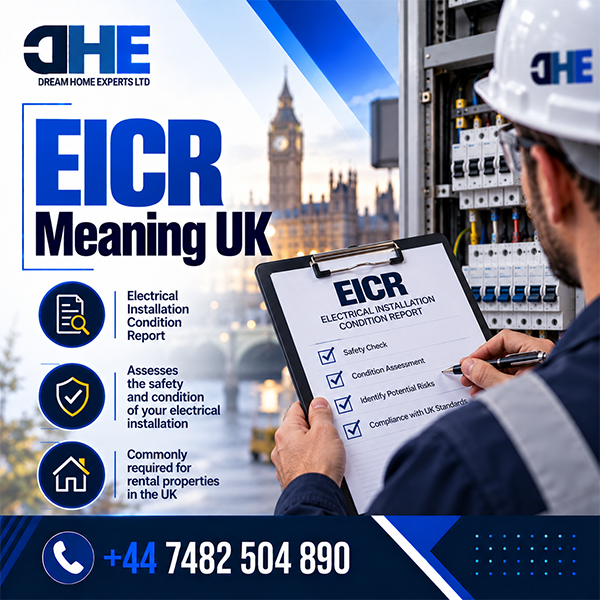
EICR meaning UK confuses a lot of homeowners and landlords the first time they see it on a quote, a tenancy document, or a property survey. It stands for Electrical Installation Condition Report, and understanding what it actually covers makes the whole process far less intimidating.
What Does EICR Stand For, and What Does It Cover?
EICR stands for Electrical Installation Condition Report. It’s a formal inspection of a property’s fixed electrical installation, covering everything from the consumer unit to the wiring behind the walls, sockets, switches, and light fittings. Unlike a PAT test, which checks portable appliances, an EICR assesses the permanent electrical system itself.
The report identifies any damage, deterioration, or non-compliance with current wiring regulations, and classifies findings by severity:
- C1: danger present, requiring immediate action
- C2: potentially dangerous, requiring urgent remedial work
- C3: improvement recommended, though not an immediate safety concern
- FI: further investigation required to confirm a suspected issue
A property receives an overall result of either “satisfactory” or “unsatisfactory” based on these findings.
Who Needs an EICR?
Several groups have a genuine need for an EICR, either legally or practically:
- Landlords, who are legally required to have a valid EICR for rented properties in England, renewed every 5 years or at change of tenancy
- Homebuyers, often requested during conveyancing to confirm a property’s electrical safety before purchase
- Homeowners, particularly in older properties or ahead of major renovation work
- Businesses, as part of standard commercial compliance requirements
Why the EICR Meaning Matters for Landlords Specifically
Landlord EICR requirements are stricter than for owner-occupied homes. Since 2020, landlords in England have been legally required to have a valid EICR for every rented property, provide a copy to tenants, and address any C1 or C2 issues within a set timeframe. Letting agents and local authorities can request a copy, and failure to comply can result in fines.
This is one of the clearest examples of why understanding EICR meaning matters practically, not just academically. A landlord who doesn’t know what the report actually requires can miss a legal deadline without realising it.
Common Misunderstandings About EICR Meaning
A few misconceptions come up repeatedly, worth clearing up directly:
- An EICR is not the same as a PAT test. PAT testing covers portable appliances; an EICR covers the fixed wiring and installation itself.
- A “satisfactory” result doesn’t mean perfect. It means no C1 or C2 issues were found, though C3 recommendations may still be noted.
- An EICR isn’t a one-off certificate that lasts forever. It has a recommended renewal period, typically 5 years for most residential and commercial properties.
- Passing an EICR doesn’t guarantee no future faults. It reflects the property’s condition at the time of inspection, not a lifetime guarantee.
Understanding EICR meaning properly, rather than assuming it works like a one-time pass or fail test, helps property owners plan for renewal rather than being caught out when the next deadline arrives.
What an EICR Typically Costs
Pricing varies by property size and number of circuits, but as a general guide, smaller properties cost less than larger homes or commercial premises with more extensive wiring to test. The only reliable way to get an accurate figure is a quote based on the specific property, since online estimates rarely reflect real-world variation in circuit count and access.
How Long Does an EICR Take, and What Happens Next?
A standard EICR on a typical home usually takes two to four hours, depending on the property’s size and number of circuits. Larger or more complex properties can take longer. Once complete, the electrician provides a written report with the classification codes explained, along with recommendations for any remedial work needed to bring an unsatisfactory result up to standard.
If issues are flagged, most electricians can quote for the remedial work at the same time, though there’s no obligation to use the same contractor for any follow-up repairs.
EICR vs Other Electrical Certificates
It’s easy to confuse an EICR with other electrical paperwork. A few quick distinctions:
- EICR: assesses the condition of existing wiring, typically renewed every 5 years
- EIC (Electrical Installation Certificate): issued after new electrical work is completed, confirming it meets current regulations
- Minor Works Certificate: issued for smaller jobs that don’t involve a full new circuit, such as adding a socket
Knowing which certificate applies to a given situation avoids confusion when a landlord, buyer, or insurer asks for specific paperwork.
Getting an EICR for Your Property
Now that EICR meaning UK is clear, the next step is booking a qualified electrician to carry one out. Dream Home Electrical has carried out EICRs for landlords, homeowners, and businesses across Milton Keynes for 35 years, as a NICEIC-approved contractor, providing clear reports and honest advice on any remedial work needed.
Need an EICR for your property? Get in touch with our team for a free quote, or call us on 01908 464431.
Frequently Asked Questions
What does EICR stand for?
Electrical Installation Condition Report, a formal inspection of a property’s fixed electrical wiring and installation.
How often do landlords need an EICR?
Every 5 years, or at each change of tenancy, under current English rental regulations.
What’s the difference between C1, C2, and C3 on an EICR?
C1 is immediate danger, C2 is urgent but not immediate, and C3 is a recommended improvement.
Do homeowners need an EICR by law?
Not by law, but it’s recommended for older properties, before renovations, or during a home purchase.
How long does an EICR take to complete?
Usually two to four hours for a standard home, longer for larger or more complex properties.
What happens if my EICR result is unsatisfactory?
Any C1 or C2 issues need remedial work, after which the property can be reassessed as satisfactory.