Fire Alarm Installation: 7 Essential Steps for Businesses
Safe, Compliant Systems in Milton Keynes
On this page
- Your Legal Duties as the Responsible Person
- 7 Steps to a Proper Fire Alarm Installation
- Questions to Answer Before a Fire Alarm Installation
- What Affects the Cost of a Fire Alarm Installation
- Testing and Servicing: What You Need to Do
- Records and the Fire Alarm Log Book
- Fire Alarm Installation in Existing and Changing Buildings
- Emergency Lighting Goes Hand in Hand
- Choosing a Fire Alarm Installer
- Common questions
Fire alarm installation for a business starts with your fire risk assessment, not with a catalogue of detectors. The law requires the responsible person to provide fire detection and warning where it is needed. BS 5839-1 is the British Standard code of practice that sets out how a system in non-domestic premises should be designed, installed, commissioned and maintained.
This guide explains your legal duties, the seven steps of a proper fire alarm installation, how testing and servicing work, and what records you need. It is written for business owners, landlords of commercial premises and facilities managers in Milton Keynes.
Your Legal Duties as the Responsible Person
In England, workplace fire safety is governed by the Regulatory Reform (Fire Safety) Order 2005. The “responsible person” is usually the employer, owner, landlord or anyone else in control of the premises, such as a facilities manager. Where several people share responsibility, they must work together.
GOV.UK sets out the core duties of the responsible person: carry out and regularly review a fire risk assessment, put in place and maintain appropriate fire safety measures, plan for an emergency, and give staff information and training.
Article 13 of the Order requires premises to be equipped, where necessary, with appropriate fire detectors and alarms. So the question is not “do all businesses need a fire alarm?” but “what does your risk assessment say you need?”
Does every business need an electrical fire alarm?
Not always. Home Office guidance for offices and shops says that in some small, open-plan, single-storey premises a fire would be obvious to everyone at once, and a shout of “fire” or a simple manual device may be enough. Where that is not adequate, an electrical fire warning system is likely to be needed. Most multi-room, multi-storey or public-facing premises fall into that second group.
7 Steps to a Proper Fire Alarm Installation
1. Start with the fire risk assessment
The assessment identifies who is at risk, where a fire could start and how people will escape. It sets the purpose of the system: protecting life, property or both.
2. Design to BS 5839-1
The designer decides where detectors, manual call points and sounders go, how the building is zoned and what type of detection suits each room. BS 5839-1 was revised in 2025, replacing the 2017 edition. The new edition favours automatic detection other than heat detectors in sleeping rooms in commercial buildings such as hotels.
3. Choose the right system type
Conventional systems split the building into zones and suit smaller, simpler sites. Addressable systems identify each device individually, which helps in larger or complex buildings. Wireless systems reduce cabling in occupied or sensitive buildings. The right choice depends on the building, not the budget alone.
4. Plan cable routes and power
The design covers cable types and routes, plus the panel’s power supply and battery backup. Careful routing keeps disruption low in occupied premises.
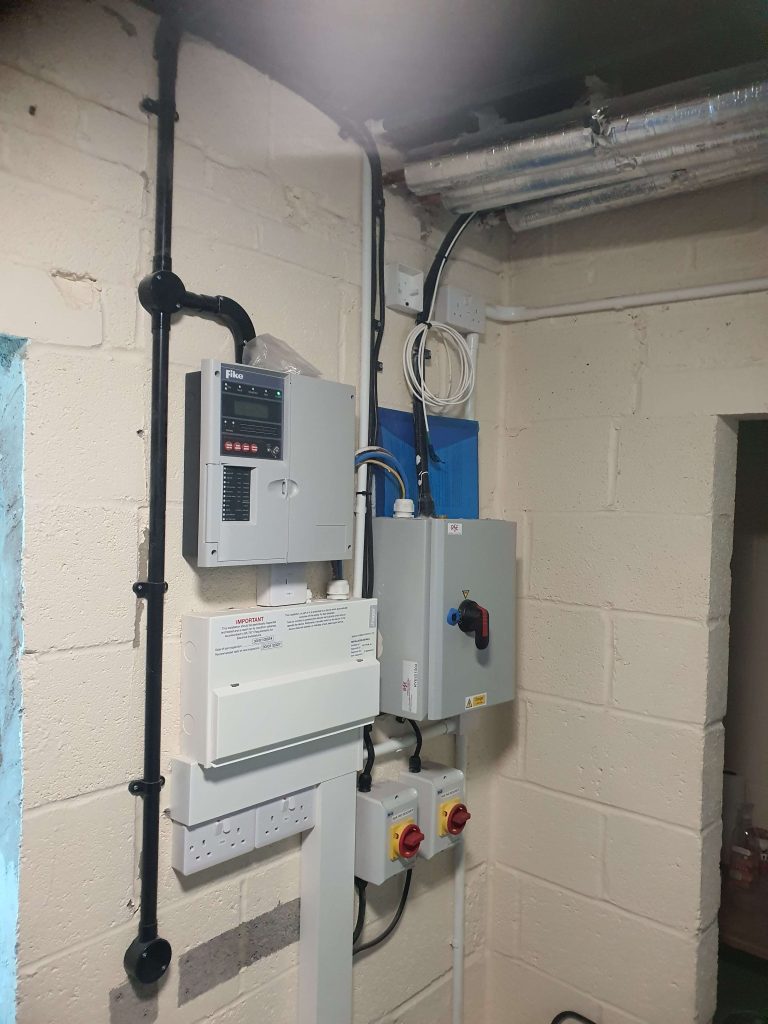
5. Install and label
Devices are fitted, cables terminated and zones labelled at the panel, so anyone responding to an alarm can find the source quickly.
6. Commission and hand over
Every device is tested, sounder levels checked and the cause-and-effect confirmed. You should receive certificates, a zone plan, operating instructions and a log book.
7. Maintain it
A fire alarm installation is only as good as its maintenance. Weekly tests and regular servicing keep it reliable and cut down on false alarms.
Questions to Answer Before a Fire Alarm Installation
A survey goes faster, and the quote is more accurate, if you have answers to these questions ready.
- How many people use the building, and at what times?
- Does anyone sleep on the premises, or work alone or out of hours?
- Are there members of the public, or people who may need help to escape?
- Is the building shared with other tenants or businesses?
- Do you need the alarm to trigger other systems, such as door releases or ventilation shutdown?
- Will the system be monitored remotely, or only sound on site?
The answers shape the design. A fire alarm installation for a single-storey shop with one exit is very different from one for a multi-tenant office block or a warehouse with a mezzanine.
What Affects the Cost of a Fire Alarm Installation
We do not publish fixed prices, because every fire alarm installation is designed for a specific building. The main cost factors are:
- The size and layout of the building, and the number of zones
- Conventional, addressable or wireless system
- How many detectors, call points and sounders are needed
- Access, ceiling heights and whether work must happen out of hours
- Links to other systems and any remote monitoring
Ask for a written quote that lists every device and states what commissioning, certificates and handover documents are included.
Testing and Servicing: What You Need to Do
The Home Office guide Fire safety risk assessment: offices and shops gives these examples of routine checks. It notes they are not prescriptive, so follow your own risk assessment and the installer’s instructions.
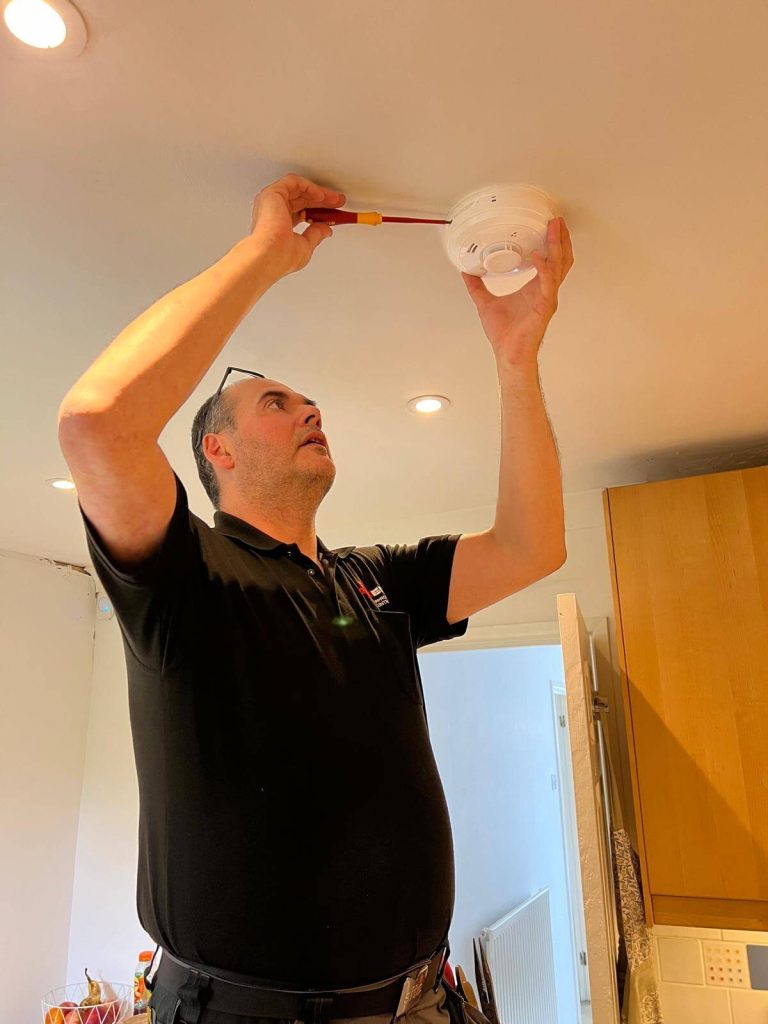
- Weekly: test the fire detection and warning system and manual call points
- Monthly: test emergency lighting
- Six-monthly: a competent person should test and maintain the fire detection and warning system
- Annually: a competent person should test and maintain emergency lighting and other installed systems
A practical tip from fire and rescue services: use a different call point each week, so every device gets tested over time.
Records and the Fire Alarm Log Book
Keep a log book for your fire alarm installation from day one. Record weekly tests, servicing visits, false alarms, faults and any changes to the system.
Fire and rescue services now expect testing and maintenance arrangements to be recorded in writing. If a fire safety officer visits, the log book is the first thing they are likely to ask for. It also helps your contractor spot patterns, such as a detector that keeps causing false alarms.
Fire Alarm Installation in Existing and Changing Buildings
A fire alarm installation designed for one use may not suit another. If you change how a building is used, add partitions, create sleeping accommodation or extend, review the fire risk assessment and check that the system still provides the right cover.
The 2025 edition of BS 5839-1 expands guidance on modifications and extensions to existing systems. In practice, any alteration should be designed, tested and certified, not simply added on.
False alarms
Repeated false alarms are not just a nuisance. They teach people to ignore the alarm. Common causes include detectors in the wrong place, such as smoke detectors near kitchens or showers, dust, poor maintenance and building work. A good design and regular servicing reduce them.
Emergency Lighting Goes Hand in Hand
If people need to escape at night or from areas without daylight, emergency lighting is part of the same fire safety picture. It should be tested monthly and serviced annually. See our guide to emergency lighting testing for more detail.
Choosing a Fire Alarm Installer
Before you agree a fire alarm installation, ask any contractor for evidence of competence, the standard they design and install to, and what certificates you will receive. Check who will service the system afterwards and how quickly they respond to faults.
Using the same firm for fire alarm installation and servicing has a practical benefit: the people maintaining the system know how it was designed, where every device is and why each choice was made.
Dream Home Experts is an NICEIC Approved Contractor and ECA member, with 35+ years of experience in the team. We handle fire alarm installation alongside emergency lighting, electrical testing and planned maintenance, so one contractor can look after the whole system. Our guide to electrical maintenance contracts explains how ongoing servicing can be scheduled.
Last checked: 31 October 2026.
Common questions
Is a fire alarm a legal requirement for my business?
The Fire Safety Order requires appropriate detection and warning where needed. Your fire risk assessment decides what is appropriate. Very small, open-plan premises may not need an electrical system.
Which standard applies to a business fire alarm installation?
BS 5839-1 is the code of practice for fire detection and fire alarm systems in non-domestic premises. The current edition was published in 2025.
How often should a fire alarm be tested?
Home Office guidance suggests a weekly test by the user and servicing by a competent person every six months, as examples. Follow your risk assessment and the installer’s instructions.
Who is responsible for the fire alarm in a shared building?
Everyone with control of the premises can be a responsible person. Landlords and tenants must cooperate, so agree in writing who installs, tests and services each part of the system.
Can you add to an existing fire alarm system?
Yes. Extending an existing fire alarm installation is common, but alterations should be designed, tested and certified, and checked against the fire risk assessment.
Planning a new system or need a fire alarm serviced? Visit our commercial electrical services page or call 01908 464 431. We offer 24/7 emergency call-outs for business clients.
Power problem right now?
24/7 emergency electricians across Milton Keynes.