kVA Calculator for Businesses: 5 Simple Steps to Size Power
On this page
- How Much Power Does My Business Need? The Short Answer
- Understanding Power: Watts, Amps and Phases
- Five Steps Before You Use a kVA Calculator
- How to Calculate kVA: A Simple kVA Calculator
- How Much Power Does My Business Need for Common Uses?
- Signs Your Supply Is Not Enough
- Upgrading Your Supply
- Don’t Forget EV Chargers and Heat Pumps
- Common questions
How much power does my business need? A kVA calculator answers it in the units your network operator uses, once you know your peak demand: the most electricity your site draws when everything that can run at the same time is running. You work it out from your equipment ratings, how you actually use them, and your plans for growth, then compare it with the capacity of your existing supply.
This guide walks through that process in five steps, with a simple kVA calculator and the warning signs that your current supply is struggling.
How Much Power Does My Business Need? The Short Answer
Most small offices and shops run comfortably on a single-phase supply. Sites with commercial kitchens, workshop machinery, large refrigeration, several EV chargers or heat pumps often need a three-phase supply, or a bigger one than they have now.
On surveys, the most common mistake we see is sizing a supply for today only. A business adds a machine or two chargers a year later, and the supply is short again. The only reliable way to know is to add up your loads properly and, ideally, measure what you use today. Guessing tends to go wrong in both directions.
Understanding Power: Watts, Amps and Phases
Three terms do most of the work.
- Kilowatts (kW) – how much power equipment uses. A 3 kW heater uses 3 kW while it runs.
- Amps (A) – the current drawn. Your supply has a maximum current, set by the main fuse or circuit breaker.
- Phases – a single-phase supply has one live conductor. A three-phase supply has three, which spreads heavy loads and suits large motors.
The UK declared voltage between phase and neutral is 230 volts under the Electricity Safety, Quality and Continuity Regulations 2002. For simple resistive loads, power in watts is roughly volts multiplied by amps. So 100 A on a single phase is about 23 kW, and the same current on each of three phases is about three times that. The kVA calculator section below gives the exact formulas. Motors and some electronics draw a little more current than this simple sum suggests.
Five Steps Before You Use a kVA Calculator
1. List every piece of equipment
Walk the site and note each item’s rating from its data plate or manual, in kW or amps. Include lighting, heating, cooling, IT, kitchen kit, machinery and chargers.
2. Work out what runs at the same time
Not everything runs at full power together. An electrician applies “diversity” to estimate realistic peak demand. A kettle and a dishwasher may run together at lunch; a welder and a compressor may never overlap.
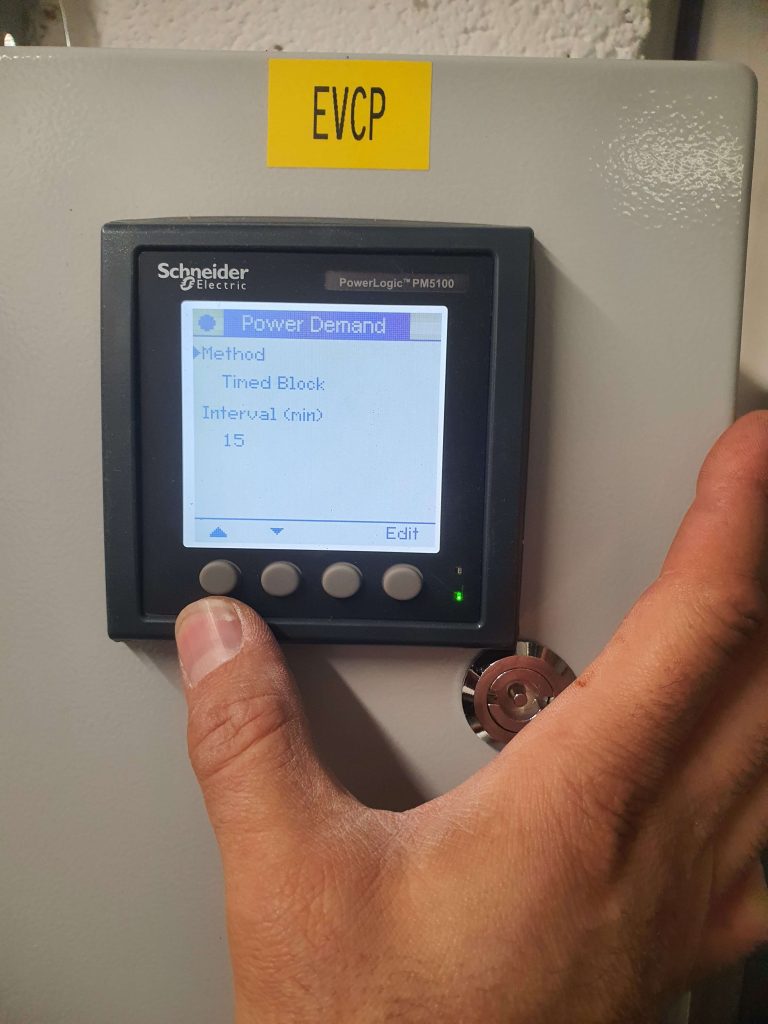
3. Measure what you use now
If you already trade from the site, real data beats any estimate. Half-hourly meter data from your supplier, or a load logger fitted for a typical week, shows your true peak, which is the figure to put into a kVA calculator.
4. Add your plans
Include equipment you expect to add in the next few years: more staff, a new machine, EV chargers or electric heating. Ask how much power does my business need in three years, not just today. Planning now is usually cheaper than a second upgrade later.
5. Compare with your supply
Check your main fuse rating and number of phases. If the peak, plus a sensible margin, is close to or above that limit, you need to act. The kVA calculator below turns your peak current into the figure suppliers quote.
How to Calculate kVA: A Simple kVA Calculator
Suppliers and network operators often talk in kVA (kilovolt-amperes) rather than kW. kVA is apparent power: volts multiplied by amps, before any allowance for power factor. Use this kVA calculator with the peak current you measured or estimated.
- Single phase: kVA = V × A ÷ 1000, using 230 V.
- Three phase: kVA = √3 × V × A ÷ 1000, using 400 V between phases (230 V × √3, rounded).
Worked example: a unit with a peak of 60 A on each phase of a three-phase supply needs about 1.732 × 400 × 60 ÷ 1000 = 41.6 kVA. The same 60 A on a single-phase supply is 230 × 60 ÷ 1000 = 13.8 kVA.
Treat any kVA calculator result as an estimate. Ask an electrician to confirm your figures before you order a supply upgrade.
How Much Power Does My Business Need for Common Uses?
Every site is different, so treat these as patterns rather than figures.
- Offices – mainly IT, lighting and small kitchen loads. Electric heating or air conditioning can change the picture.
- Shops – lighting, tills and sometimes chilled displays. Refrigeration is often the largest load.
- Cafes and restaurants – ovens, fryers, dishwashers and extraction add up quickly. Three-phase is common.
- Workshops and light industrial units – motors, compressors and welders drive demand. Starting currents matter.
- Warehouses – storage-only sites can need little power. Conveyors, racking lights and charging forklifts change that.
Run each of these through a kVA calculator and you get a different answer, even in the same size of building.
Signs Your Supply Is Not Enough
Sometimes the building answers how much power does my business need for you, by tripping or struggling.
- The main breaker or fuses trip when several machines start together
- Lights dim when large equipment starts
- Motors struggle to start or overheat
- You have had to stagger equipment use to avoid trips
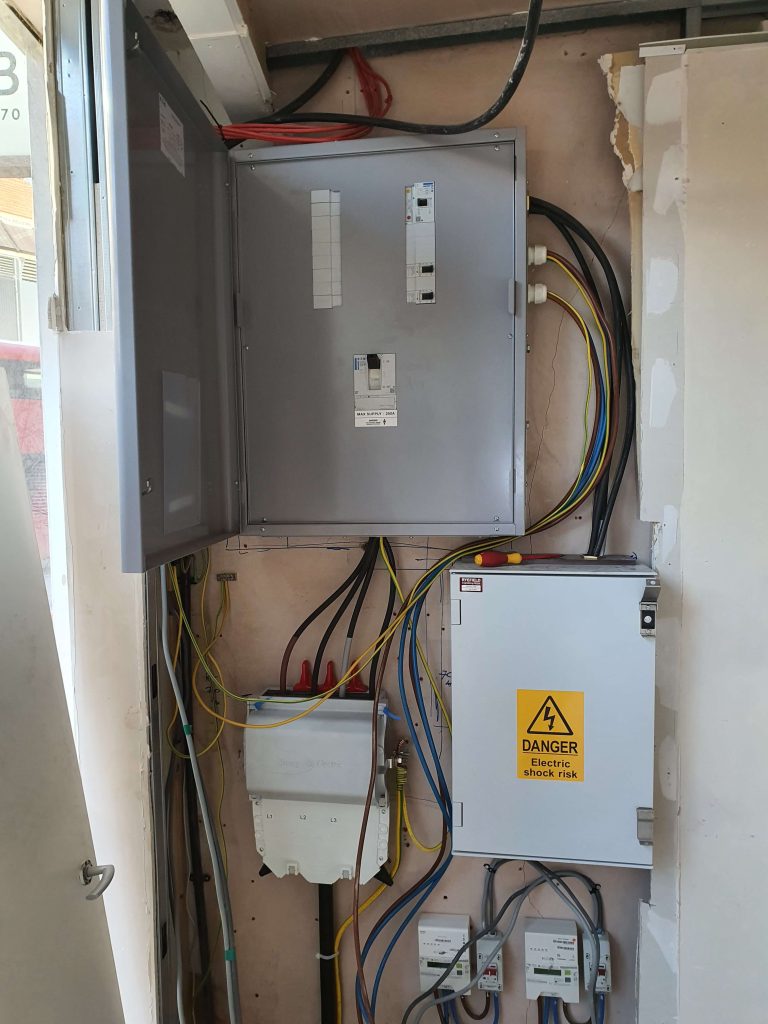
- Cables, switchgear or the distribution board feel warm or smell hot
Warmth or burning smells are a safety issue, not just a capacity one. Switch off the affected circuit if it is safe to do so and call an electrician. We offer a 24/7 emergency service for businesses.
Upgrading Your Supply
If the answer to how much power does my business need is more than you have, there are two parts to the job. The cable into your building, the cut-out and the main fuse belong to your distribution network operator (DNO). Everything after the meter is your installation.
The Energy Networks Association lets you find your DNO by postcode. Your electrician can help you apply, check your kVA calculator figures and prepare your installation. Lead times and costs vary by site and network, so start early if you have equipment on order.
Inside the building, an upgrade may mean a new distribution board, new sub-mains and better load balancing across phases. Our guide to three phase vs single phase explains that choice in more detail.
Don’t Forget EV Chargers and Heat Pumps
Electrification is the most common reason businesses ask how much power does my business need today. A single 7 kW charger draws about 32 A for hours at a time. In kVA calculator terms, that is about 7.4 kVA on a single-phase supply. Several of them, or a 22 kW unit, can match the rest of a small site’s load. Load management can help, but it needs planning. See our guide to EV charger types for the options.
Common questions
How do I find my current supply capacity?
Look for the rating on the main fuse or cut-out, or ask an electrician to check. Larger sites may have an agreed capacity in their supply agreement.
How much power does my business need for a small office?
Often less than owners expect. Modern LED lighting and laptops draw little, so many small offices sit well within a single-phase supply. Electric heating, air conditioning or EV chargers can change that.
Do I need three-phase power?
If you run large motors, commercial kitchens, several EV chargers or heavy machinery, probably. Most small offices do not.
Can an electrician tell me how much power my business needs?
Yes. A site survey, a load calculation and ideally a period of load logging give a reliable answer, and one more dependable than any online kVA calculator.
Is a bigger supply always better?
No. A larger connection can cost more to install and may bring higher charges. Size it to your realistic peak plus planned growth.
Used our kVA calculator and still unsure how much power your business needs? Our NICEIC approved commercial electricians, with 35+ years of experience, can survey your site. Visit our commercial electrician page or call 01908 464 431.
Power problem right now?
24/7 emergency electricians across Milton Keynes.