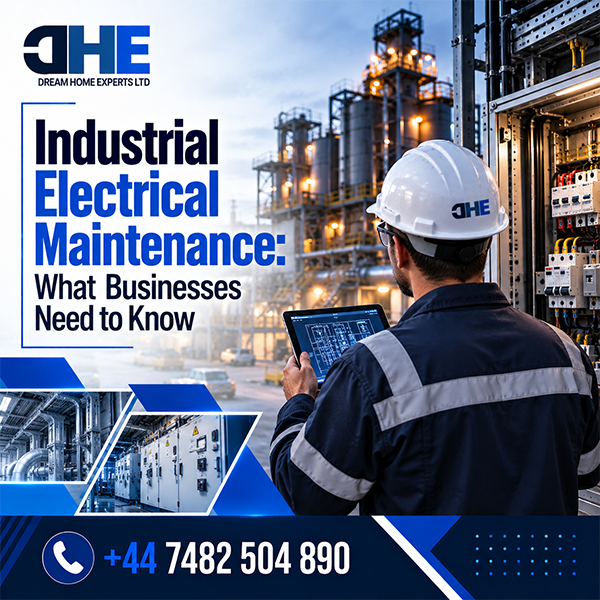
Industrial electrical maintenance keeps factories, warehouses, and production sites running without the unplanned downtime that heavy machinery faults tend to cause. Unlike a standard office, indusذtrial sites carry higher loads, more complex equipment, and a much steeper cost when something fails mid-shift.
What Industrial Electrical Maintenance Actually Covers
This kind of work is broader than a standard commercial service visit. It typically includes:
- Three phase system checks on motors, compressors, and heavy machinery
- Distribution board inspections for panels carrying higher loads than office-grade boards
- Thermal imaging surveys to spot overheating connections before they fail
- PAT testing for portable tools and equipment used across the site
- Emergency lighting and fire alarm testing required across factory floors and warehouses
- EICR inspections, often on shorter cycles than standard commercial premises due to higher risk
- Machinery-specific electrical servicing, coordinated with production schedules to limit disruption
Why Industrial Sites Need Shorter Maintenance Cycles
Standard commercial EICRs run on a five-year cycle. Industrial sites often need testing every one to three years instead, because heavy machinery, higher ambient temperatures, and continuous operation all accelerate wear on wiring and connections. A cable insulation rating that’s fine in an office environment can degrade faster in a factory running equipment around the clock.
Vibration from machinery is another factor rarely considered outside industrial settings. Connections that stay tight in a static office environment can work loose over months of continuous vibration, which is why thermal imaging and physical inspection matter more here than in lighter commercial work.
The Cost of Skipping Industrial Electrical Maintenance
An unplanned electrical failure on a production line costs far more than the repair itself. Consider what’s actually at stake:
- Lost production time, often calculated in thousands of pounds per hour on larger sites
- Damaged stock or work-in-progress if refrigeration or process equipment fails
- Emergency callout rates, which run higher than scheduled visits
- Potential HSE involvement if the failure caused injury or a near-miss
- Insurance disputes if maintenance records can’t show reasonable care was taken
Planned maintenance spreads these costs into predictable, scheduled visits instead of unplanned emergencies that hit during production hours.
Building an Industrial Maintenance Schedule
A good schedule for this kind of work usually combines several layers:
- Daily visual checks by site staff for obvious warning signs
- Monthly functional tests of emergency lighting and fire alarm systems
- Quarterly or biannual inspections of high-risk equipment and distribution boards
- Annual PAT testing across portable tools and equipment
- Periodic EICRs, timed to the site’s specific risk level rather than a generic five-year default
Facilities around Kiln Farm and Knowlhill, where light industrial and warehouse units cluster, often settle into a maintenance rhythm built around their specific machinery rather than a one-size-fits-all commercial template.
Common Risks a Maintenance Plan Should Catch
Certain issues turn up repeatedly during industrial site inspections. Being aware of them helps a maintenance plan focus on what actually causes failures rather than generic checklist items:
- Overloaded distribution boards installed years ago for less demanding equipment than what’s running today
- Damaged cable insulation from heat, chemical exposure, or physical wear near machinery
- Poor earthing on older installations that predate current safety standards
- Dust and debris buildup inside panels, particularly on sites with significant airborne particulates
- Undersized cabling for equipment added after the original installation without a full capacity review
None of these show up during a quick visual glance. They surface during a proper inspection, which is part of why industrial sites benefit from more frequent, more thorough checks than a standard office ever needs.
Who Should Be Involved in the Maintenance Process
This kind of work rarely succeeds as a purely reactive relationship between site management and an outside contractor. The sites that manage it best tend to involve a few consistent roles:
- A site manager or facilities lead who owns the maintenance schedule and liaises with the electrician
- Production supervisors who flag equipment behaving unusually before it becomes a full failure
- A qualified industrial electrician carrying out scheduled inspections, testing, and emergency response
- Insurance and compliance contacts who need visibility of maintenance records when required
Getting this structure right from the start avoids the common scenario where maintenance happens inconsistently because no one person is clearly responsible for it.
Getting an Industrial Electrical Maintenance Plan Set Up
Industrial electrical maintenance works best when it’s designed around your actual site and equipment, not adapted from a standard commercial checklist. Dream Home Electrical has 35 years of experience working on industrial and warehouse electrical systems across Milton Keynes, and our industrial team can build a maintenance schedule that fits your production timetable rather than working against it.
Need an industrial electrical maintenance plan for your site? Get in touch with our industrial team for a free site assessment, or call us on 01908 464431.
Frequently Asked Questions
How often does an industrial site need an EICR?
Typically every 1 to 3 years, shorter than the standard 5-year commercial cycle, due to higher wear and risk.
What’s the biggest cause of industrial electrical failures?
Loose connections from vibration and heat stress, often caught early with thermal imaging surveys.
Can industrial maintenance be scheduled around production hours?
Yes. Most industrial electricians plan visits to minimise disruption to live production schedules.
Is thermal imaging necessary for industrial sites?
It’s strongly recommended, since it catches overheating connections before they cause a failure or fire.
How much does industrial electrical maintenance typically cost?
It varies by site size and equipment; a site survey gives an accurate, tailored figure.
What happens if industrial maintenance is skipped entirely?
Higher risk of unplanned downtime, equipment damage, HSE involvement, and challenged insurance claims.