Three Phase Installation: 6 Essential Steps for Businesses
On this page
- What a Three Phase Installation Involves
- 6 Essential Steps in a Three Phase Installation
- Who Does What
- Signs a Business Needs a Three Phase Installation
- Three Phase Installation for Different Business Types
- Costs and Timescales
- Questions to Ask the Network Operator
- Preparing for Switchover Day
- After the Installation: Keeping It Safe
- Common Mistakes to Avoid
- Choosing a Contractor
- Common questions
A three phase installation gives a building three live supply conductors instead of one, so it can run heavy equipment and much higher loads. Businesses usually need one when they add machinery, a commercial kitchen or a bank of EV chargers. This guide walks through the six steps of a three phase installation, who does what, and how to keep disruption low.
Not sure yet whether you need three phase at all? Start with our comparison of three phase vs single phase, then come back here for the project itself.
What a Three Phase Installation Involves
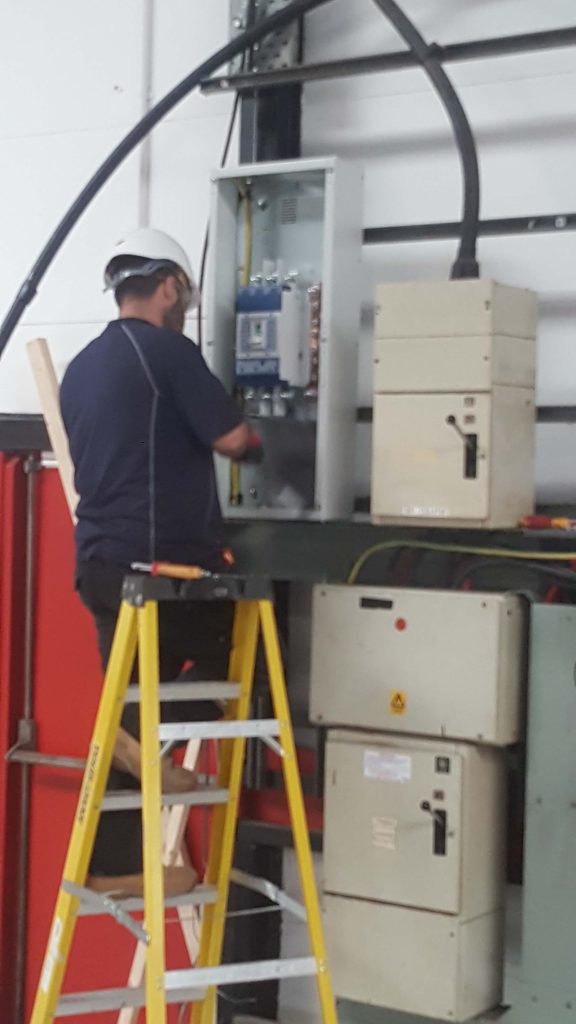
A three phase installation has two halves. The network operator owns the supply cable to your building and the cut-out where it ends. Everything after the meter, including the main switch, distribution boards and circuits, is your installation and is the electrician’s work.
Both halves must match. There is no point fitting a three phase board if the incoming supply is single phase, and no point upgrading the supply if the internal wiring cannot use it.
In Great Britain, the declared low voltage is 230 volts between phase and neutral, under regulation 27 of the Electricity Safety, Quality and Continuity Regulations 2002. On a three phase supply, that gives roughly 400 volts between phases, which is what larger motors and machines use.
6 Essential Steps in a Three Phase Installation
1. Assess the load
List the equipment you have now and plan to add, with ratings from each rating plate. Include heating, cooling, lighting, IT, machinery and EV chargers. This tells you how much capacity you need and how to split loads across phases. Our guide on how much power your business needs explains how to start.
2. Check what the network can supply
Contact your local network operator. If you do not know who that is, call 105 or use the postcode search on powercut105. The operator will confirm what capacity is available, what their work involves and what it will cost. Their quote and timescale often set the pace of the whole project.
3. Design the internal installation
The electrician designs the new main switch, distribution board or boards, sub-main cables and final circuits. A good design balances loads across the three phases, so one phase is not overloaded while the others sit idle.
4. Plan the switchover
The changeover from the old supply to the new one usually means a planned power-off. Agree the date with the network operator and the electrician, and choose a quiet period such as early morning, evening or a weekend.
5. Install, connect and label
The electrician installs the new board and circuits, transfers existing circuits, and labels everything clearly. Single phase circuits for lighting and sockets are reconnected to the new board and spread across the phases.
6. Test and certify
Every three phase installation must be tested before use. You should receive certification for the new work to BS 7671, the current edition being BS 7671:2018+A4:2026. Keep it with your other electrical records.
Who Does What
- Network operator: the supply cable, the cut-out and any network reinforcement.
- Energy supplier: usually arranges a suitable meter.
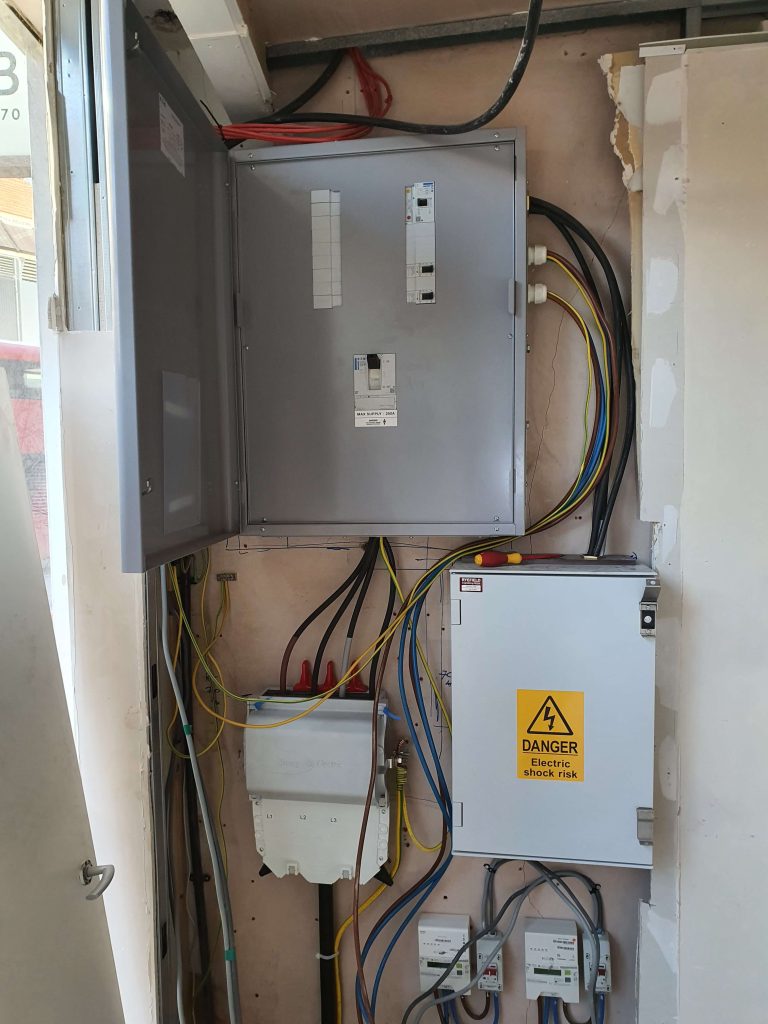
- Electrician: design, installation, testing and certification of everything after the meter.
- You: the load list, access, and agreeing the switchover time with staff.
Our practical comment: the most common delay on a three phase installation is waiting for network dates. Contact the operator early, even before you finalise equipment, so their timescale is known.
Signs a Business Needs a Three Phase Installation
- New equipment has a 400V or 3-phase rating plate.
- The main fuse or breakers trip at busy times.
- Lights dim when large machines start.
- You plan 22 kW AC EV chargers, or several chargers at once.
- You are fitting out a commercial kitchen, workshop or production area.
If supply equipment is hot, smells of burning or shows scorch marks, do not wait for a project. Switch off if it is safe to do so and call our 24/7 emergency electricians.
Three Phase Installation for Different Business Types
Workshops and factories
Machinery, compressors and extraction usually drive the need. Plan dedicated circuits and isolation points close to each machine.
Commercial kitchens
Ovens, dishwashers and extraction draw heavy loads at the same time. Load balancing matters, because peaks often happen during service.
Offices and retail
Many run on single phase. A three phase installation becomes worthwhile when heating, cooling, lifts or EV charging push demand up.
EV charging sites
Faster AC chargers and multiple chargers often need three phase. Load management can sometimes reduce the supply size you need.
Costs and Timescales
There is no fair single price. The network operator’s charge depends on local capacity, distance and whether the street network needs reinforcing. The internal cost depends on the number of boards, cable lengths and how much existing wiring must be transferred.
Get the network operator’s quote first, then an itemised quote for the internal three phase installation. Ask both for timescales. Internal work is often the quicker part.
Items that usually affect the internal price include the number and size of distribution boards, the length and route of sub-main cables, whether existing circuits need upgrading as well as transferring, and how much of the work must happen out of hours. Ask for each to be shown separately so you can compare quotes fairly.
Questions to Ask the Network Operator
Going in prepared saves weeks of back and forth. Have your load list ready and ask:
- What capacity is available at this address now?
- Does the street network need reinforcing, and who pays for it?
- Where will the new cut-out and meter position be?
- What is the lead time from acceptance to connection?
- What do you need from our electrician before the switchover?
Share the answers with your electrician straight away. The position of the new cut-out, in particular, affects where the main board goes and how long the cables need to be.
Preparing for Switchover Day
The switchover is the only part of a three phase installation that normally needs the whole building off. A little planning keeps it short.
- Tell staff and tenants the date and expected off period in writing.
- Shut down servers, tills and production equipment in a controlled way.
- Check fridges and freezers can hold temperature for the off period.
- Make sure the electrician and network operator have clear access to the intake and boards.
- Have someone on site who can confirm each system is working afterwards.
After the Installation: Keeping It Safe
A new installation still needs looking after. Regulation 4 of the Electricity at Work Regulations 1989 requires systems to be maintained, where necessary, to prevent danger. In practice that means periodic inspection at the interval set on your report, and a fresh look at phase loads whenever you add significant equipment.
Our practical comment: keep the board schedule up to date. When the next machine or charger arrives, a clear record of which circuits sit on which phase makes the next three phase installation change quicker and cheaper.
Common Mistakes to Avoid
- Buying equipment first: ordering three phase machines before confirming the supply can lead to months of waiting.
- Ignoring future load: sizing the upgrade only for today often means a second upgrade later.
- Poor phase balance: putting most circuits on one phase wastes capacity and can cause nuisance tripping.
- No switchover plan: an unplanned power-off during trading hours costs more than the work itself.
- Missing paperwork: without certification and an updated board schedule, the next electrician starts from scratch.
Each of these is avoidable with an early load assessment and a written plan agreed by everyone involved in the three phase installation.
Choosing a Contractor
- NICEIC Approved Contractor status, checked on the register.
- Experience with three phase boards and commercial or industrial sites.
- A written design and itemised quote.
- A clear switchover plan that suits your hours.
- Full testing and certification at the end.
Common questions
How long does a three phase installation take?
The internal work is often a matter of days. The overall timescale usually depends on when the network operator can do their part.
Do I need permission for a three phase upgrade?
You need the network operator to agree and carry out the supply upgrade. Contact them early to apply.
Can the work be done without stopping the business?
Most of it, yes. The switchover itself needs a planned power-off, which can be scheduled outside working hours.
Can existing single phase circuits stay?
Yes. They are reconnected to the new board and spread across the three phases.
Is a three phase installation worth it for a small business?
Only if your equipment or planned growth needs it. Many small premises run well on single phase. A load assessment answers the question before you spend money.
Will I get a certificate?
Yes. New work should be tested and certified to BS 7671, and you should keep the certificate with your records.
Planning a three phase installation in or around Milton Keynes? Our NICEIC approved team brings 35+ years of experience to commercial and industrial supplies. See our commercial electrical services or call 01908 464 431.
Power problem right now?
24/7 emergency electricians across Milton Keynes.